
A fleeting permission
I sometimes start an article by saying ‘back in blah blah, I wrote an article about…’, and this is one of those. The article in question is ‘Detecting with Shmee150’ and I’m referring to it because the article I’m about to write was born from the research that I did for that project.
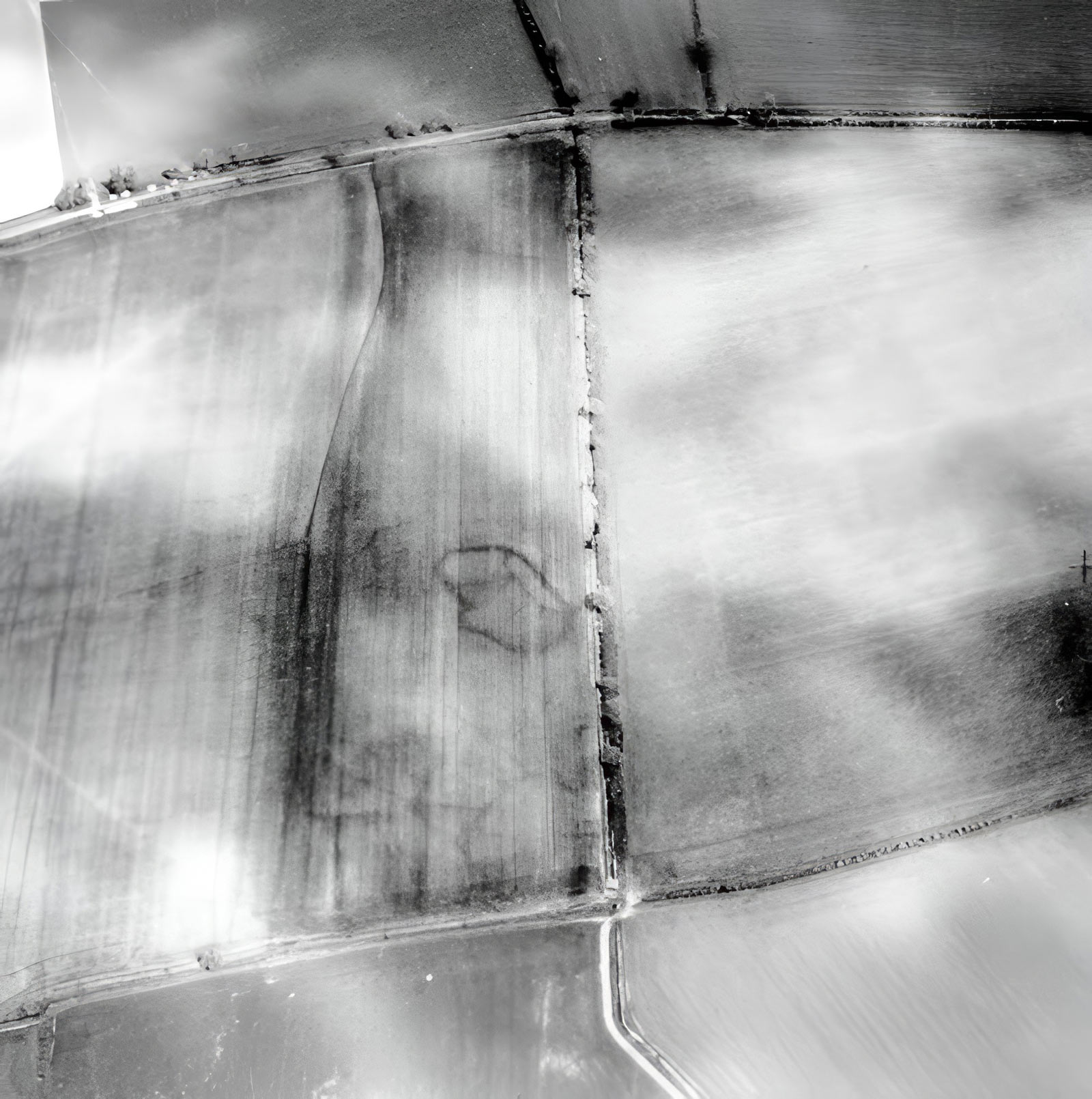
During that research I came across an old aerial photograph taken in 1972, which showed the clear outline of a feature on the land below (Fig.1). It was unmistakably some kind of enclosure or building, and the irregular shape of it meant that it couldn’t possibly be modern. I sent the image to Gil Burleigh and Keith Fitzpatrick-Mathews to take a look at thinking that they would already be aware of it, and as it turns out they weren’t. For those who don’t already know, Gil is a retired archaeologist and was responsible for the excavation of the Dea Senuna (Ashwell) Hoard, which was a nationally significant discovery. Keith is still a working archaeologist and is the Curator and Heritage Access Officer at North Herts Museums. They both reacted quite excitedly, and the irregular shape suggested to them that the feature might be prehistoric. Luckily, Gil still lives in the local area and knows the land owners, so he contacted them with a view to gaining permission to conduct some field walking research.
Shortly after revealing the aerial photo to Gil and Keith, Gil took a walk over to the field in question as it was only a short distance from where he lives. At that time the field was in crop so there was nothing to see, but Gil contacted the landowner outlining what had been found and what we would like to do. This would included some field walking exercises to be conducted by the North Hertfordshire Archaeological Society, and a metal detecting survey which would be my contribution. It wasn’t until late July that Gil came back with the following news…
“Success! I was phoned yesterday evening by the landowner giving us permission for our archaeological survey including metal detecting. He’s not doing anything to the field for the next two months so that’s our window, and maybe a further brief opportunity after ploughing. James, I think you could detect there and plot any finds anytime during our window. If you get approached by anyone, tell them you have the landowners permission and are detecting on behalf of NHAS. I’m looking forward to doing the survey and seeing the results. Best wishes, Gil”.
This was music to my ears, a two month window on a new permission that had a definite archaeological feature in it, but, once again I had to curb my enthusiasm. Although Gil and Keith hadn’t known about this particular feature, they did know that there was a probable late Iron Age and Romano-British temple site nearby. This is because back in the early 1990’s some metal detectorists had found artefacts which related to there being to such a site. What the detectorists found didn’t show up when I did a search on the Portable Antiquities Scheme website, but then the PAS database wasn’t set up until 1997, so that might explain it. This did make me wonder if they had also detected where I was about to go, so this did subdue my excitement somewhat. But then Gil came back with the following message, which did give me a little bit of hope, “I know there was some metal detecting in that field in the mid-1990s, but I think further into the field and not where you are. No finds were reported to the museum”.
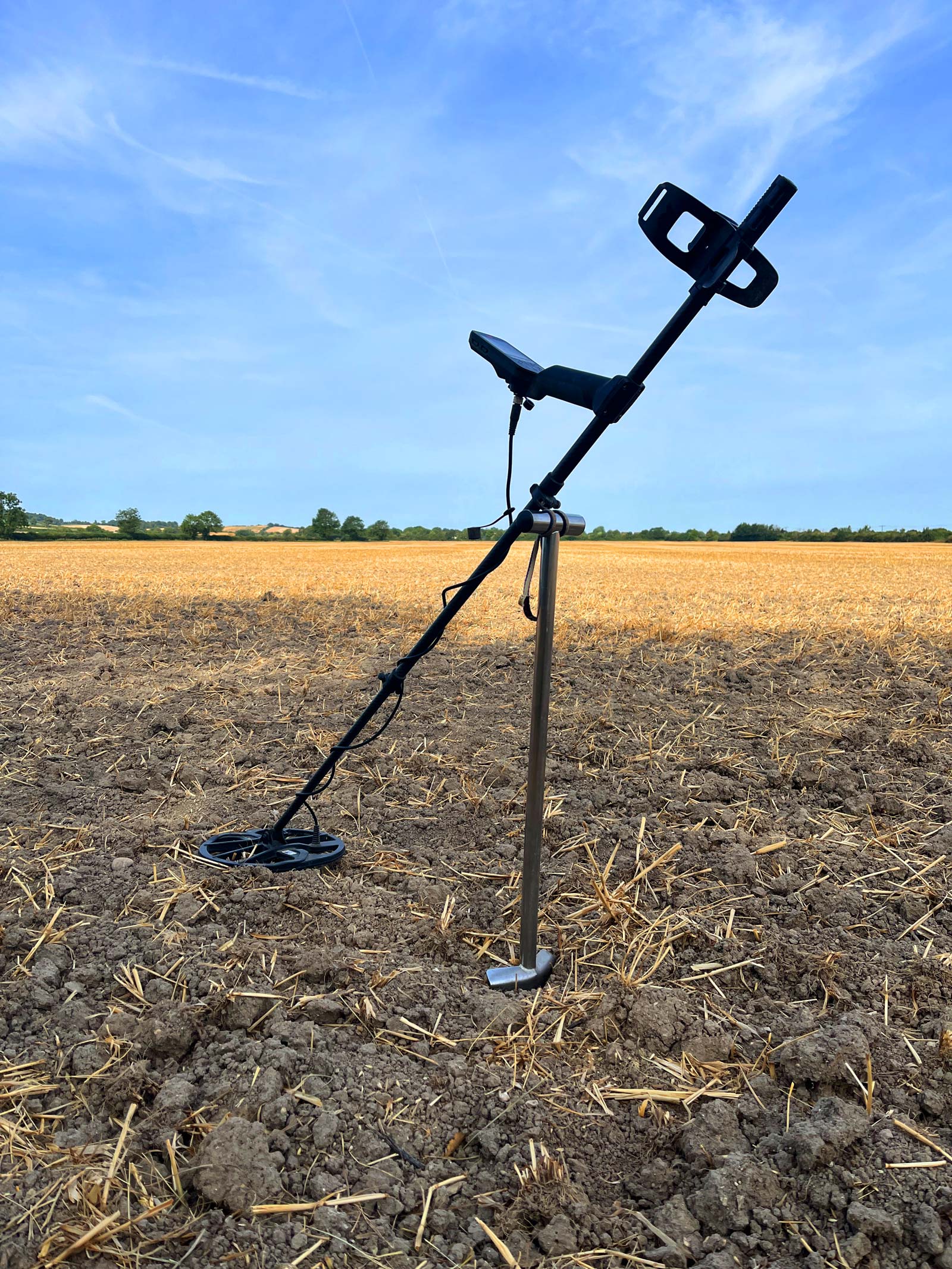
My first day on site revealed that this was going to be a difficult exercise (Fig.2). It was the beginning of August and we were in the middle of a very long, hot summer. We hadn’t seen rain for weeks so the ground was incredibly dry, dusty and hard. The initial three or four inches were quite crumbly due to the harvest, but anything below that was like rock. It didn’t look like rain was going to come anytime soon either, so I just had to make the best of it.
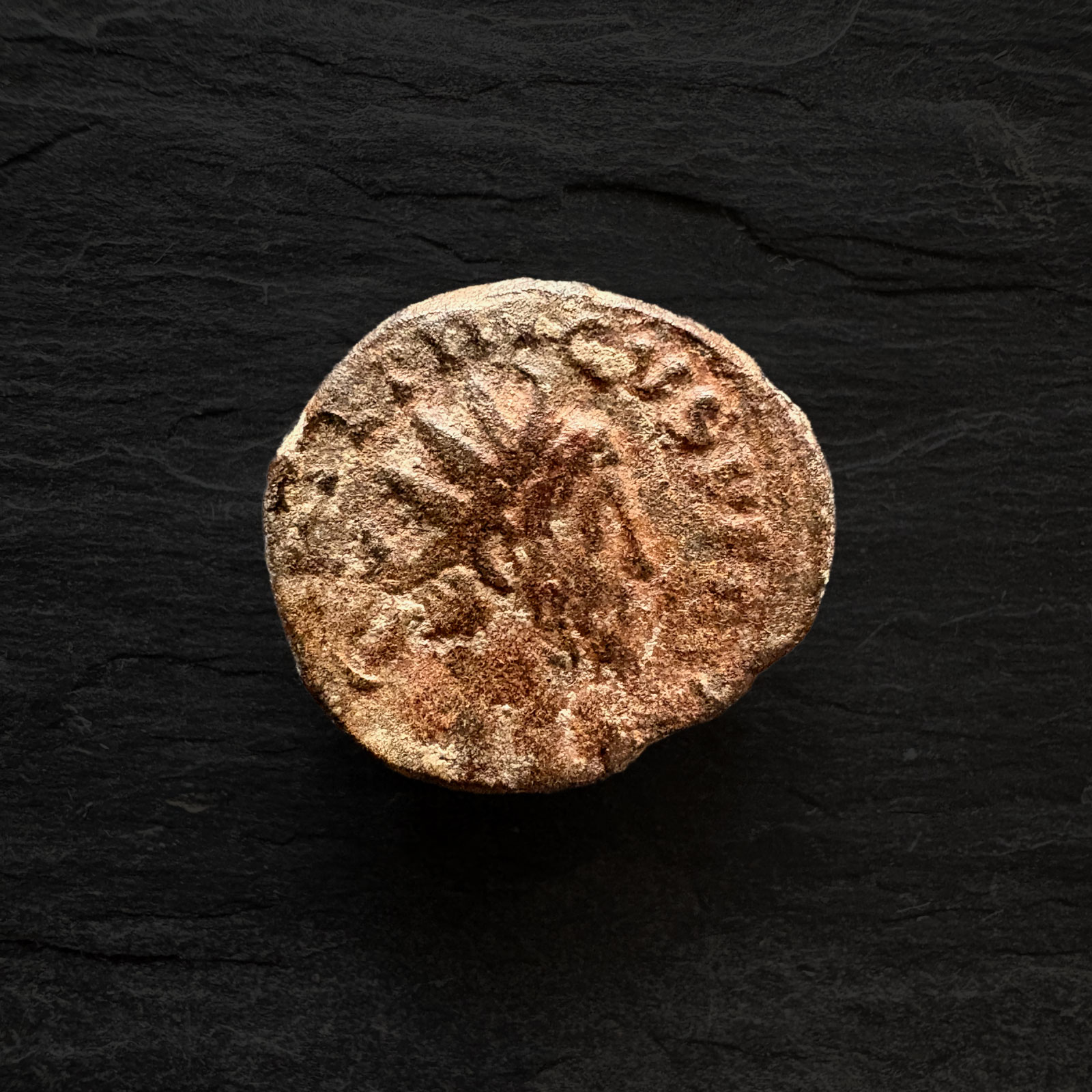
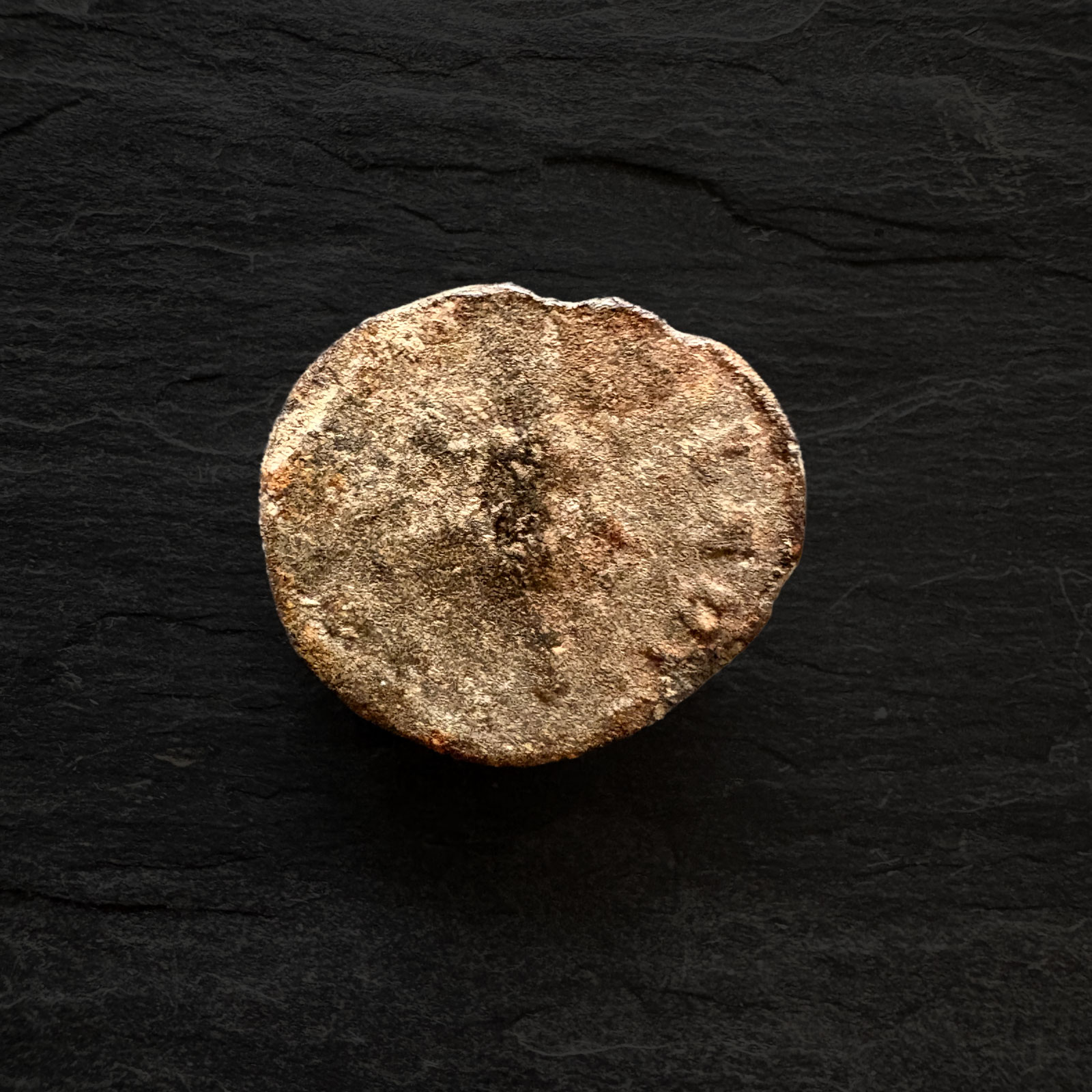
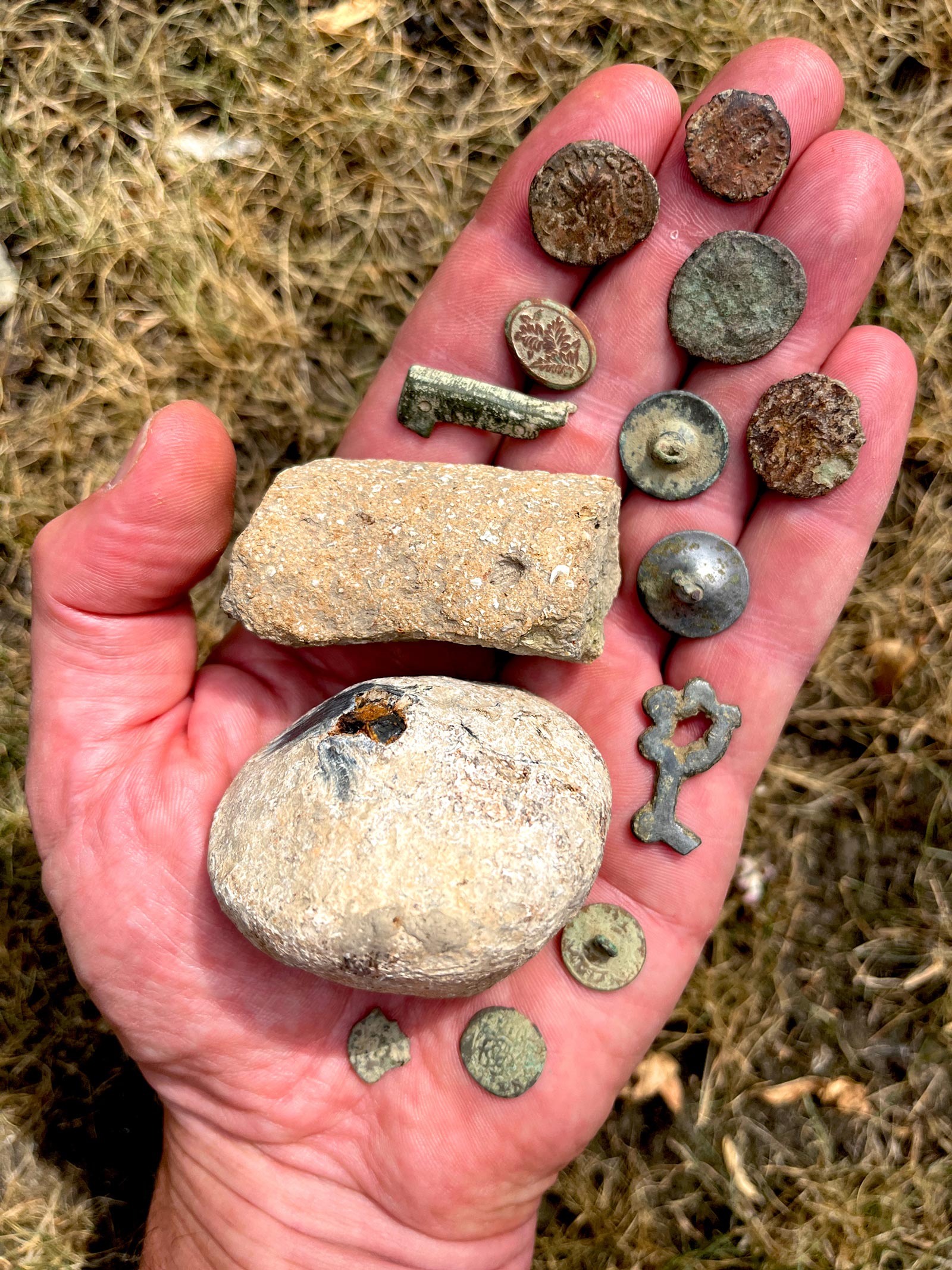
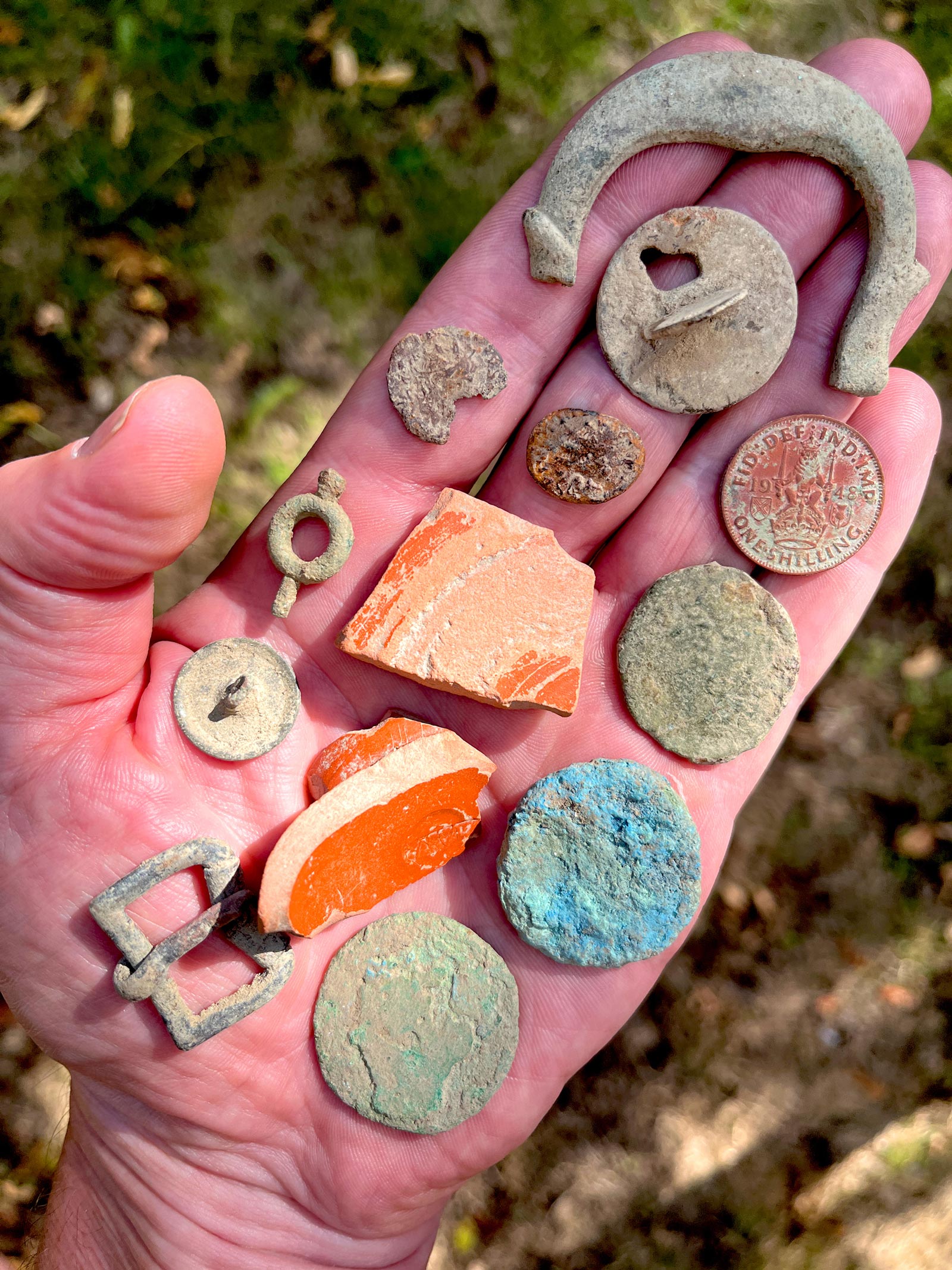
A few minutes after turning the detector on, my first target turned out to be a Roman coin (Fig.3a & 3b), a Radiate to be exact which would place it around the 3rd century AD. The coin was in pretty poor condition, which is not unusual for copper alloy coins from this period, but I considered it a great start. Although conditions were pretty tough on the digging front, this first session ended quite well. As you can see in Fig.4, I had a total of four Roman coins, a few modern buttons, a Charles I rose farthing, a huge lead steelyard weight (probably Roman) and a sherd of pottery that turned out to be late Iron Age. The pottery shared was an eyes only surface find, as was the fossil which you can see in Fig.5.
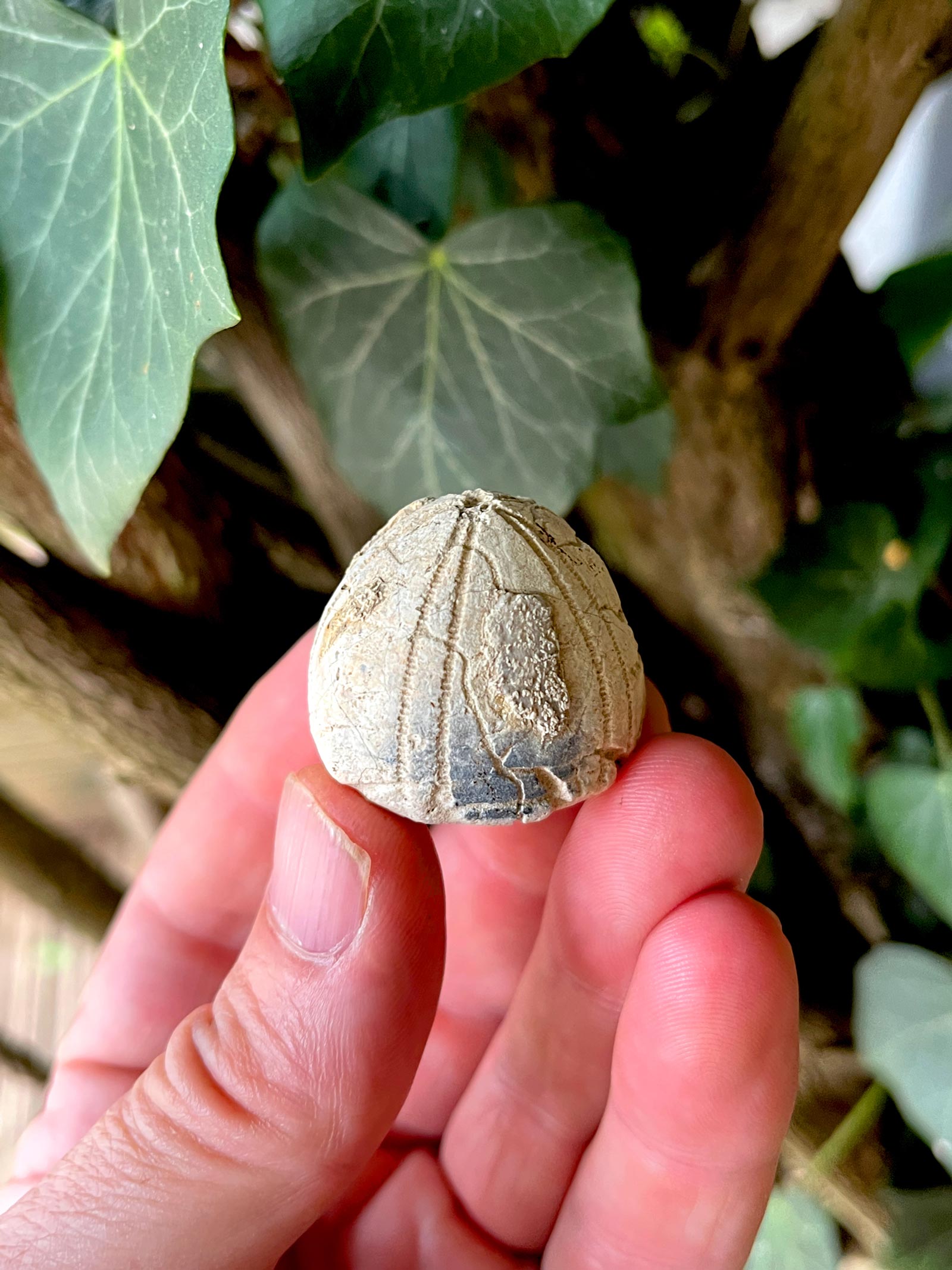
The fossil is of an echinoid (sea urchin), which I was going to give to my son who is currently studying Marine Biology at university. But I was to soon change my mind when I showed the fossil to Gil and Keith. Gil said “Fossils are often found on historic sites because people of all periods liked to collect and curate them’. Keith then added “Ammonites are called that because in the Roman world they were associated with the rams’ horns of Jupiter Ammon. I can’t instantly think of an association with echinoids, but Gil’s absolutely right to highlight the significance of fossils”. Gil then followed up by saying “They are often found on ancient religious sites so your fossil find, James, should remain part of the site archive”. So there it was, what I believed to be a random fossil find, could actually be part of someone’s fossil collection from nearly 2000 years ago, you learn something new everyday!
And it didn’t stop there, Keith went on to say, “This is what Copilot says about fossil echinoids: Fossil echinoids were widely known as thunderstones, believed to fall from the sky during storms. In Celtic and Norse folklore, thunderstones were linked to protection from lightning, fertility, and resurrection myths”.
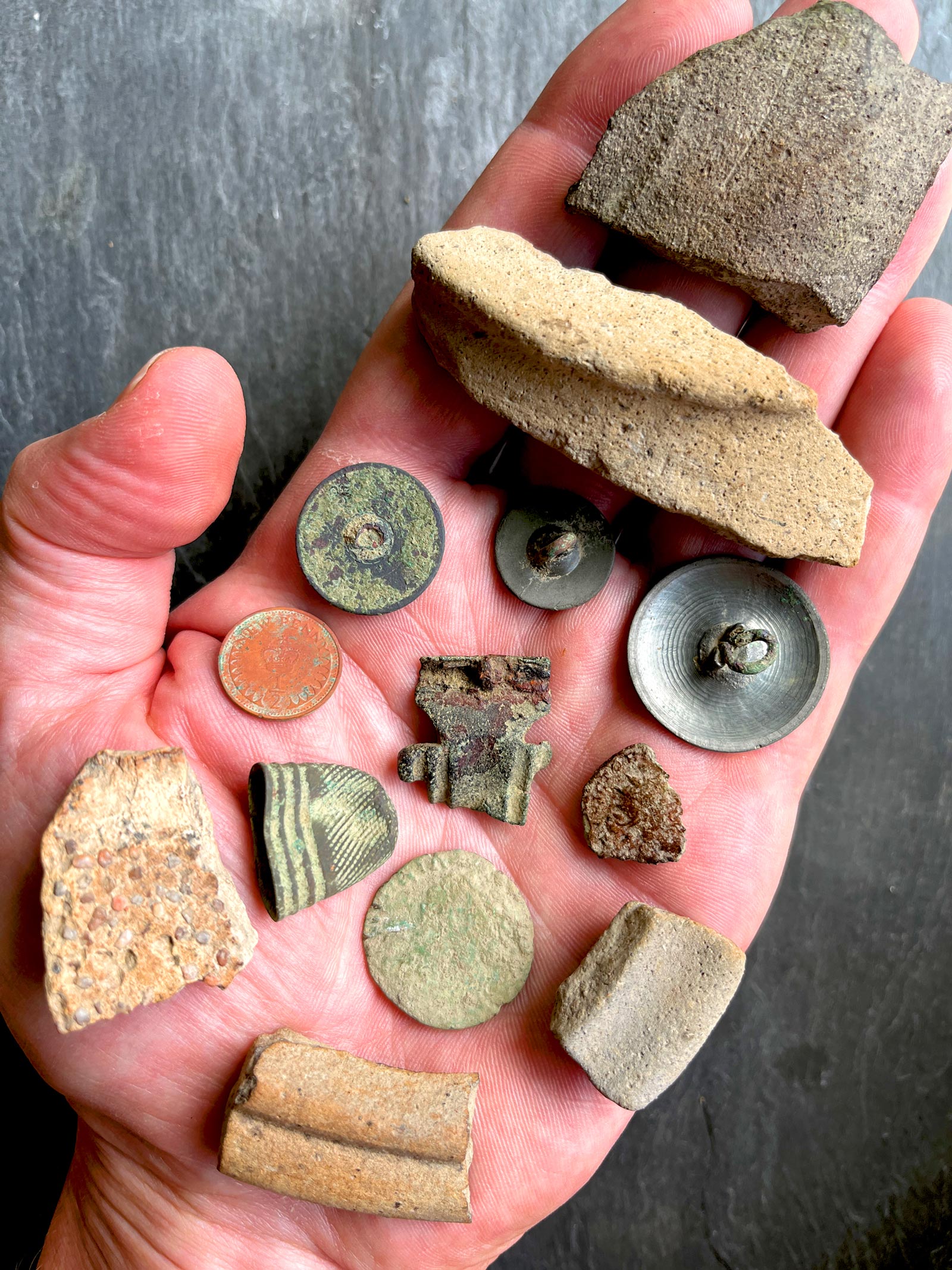
My next time out was the following weekend, and this was when I started to get my eye in for spotting pottery sherds lying around on the surface. You can see in Fig.6 where I kept a few pieces, but this was just scratching the surface. The more I looked, the more I saw, it was a bit like being able the see the image one of those magic eye posters in the early the 1990’s. Pottery sherds were literally everywhere, and the main concentrations were directly over where the feature was in the aerial photo. This session was a bit light on the metal finds front, but another Roman coin came up and part of a Roman brooch.
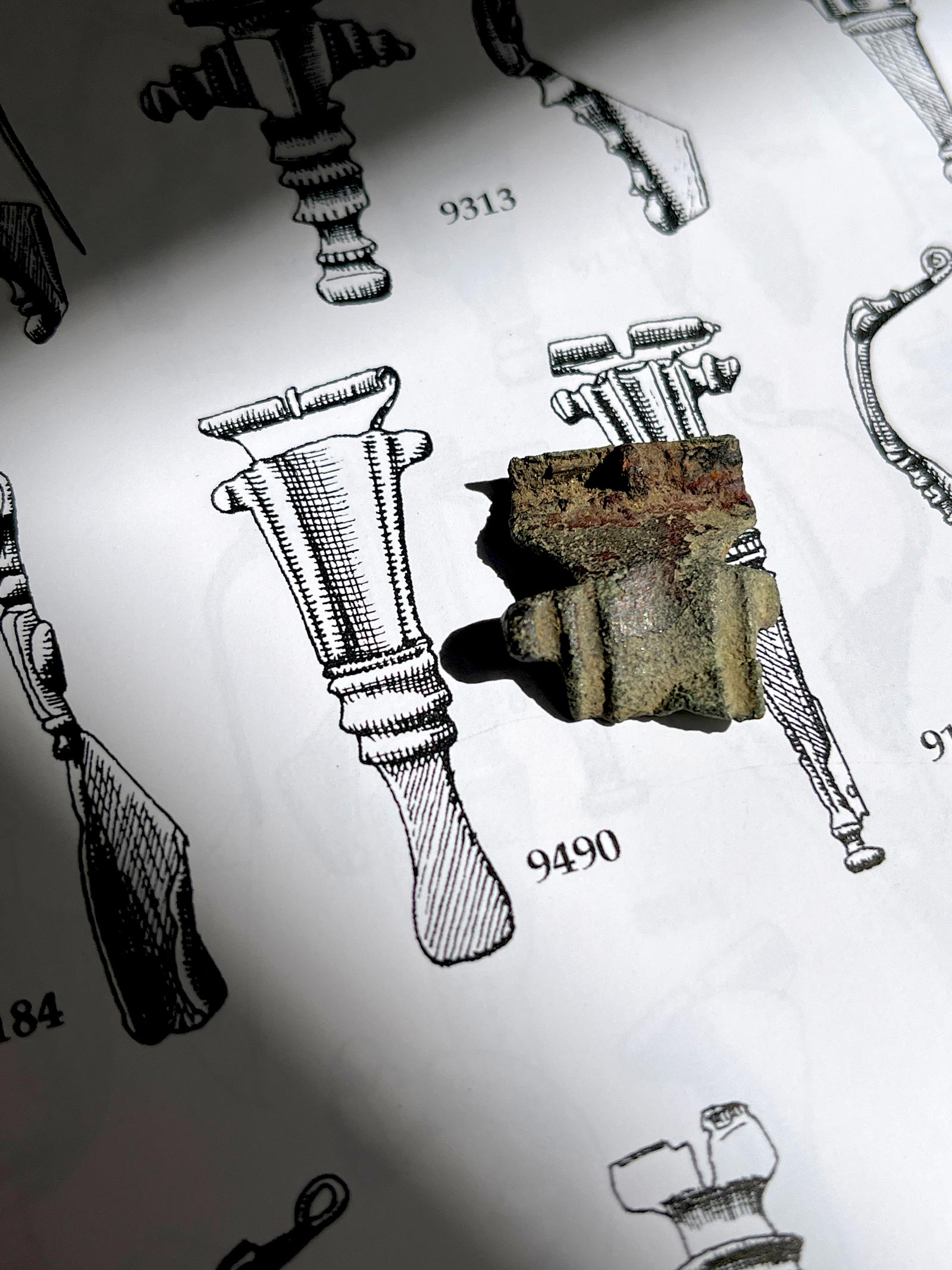
The brooch fragment seemed insignificant at first, but it was only when I got home and gave it a bit of a clean that I realised what it was. I then shared a picture of it with Keith and Gil, and within minutes Keith had messaged back. “It’s part of a Hod Hill brooch, it’s an early type, 40AD to shortly after 60AD. If you’ve got Mackreth’s book, it’s his number 9490 (Type 4.b.3)”. As it happens I did have Mackreth’s book, so I was able to see what the full brooch would have looked like (Fig.7). This was a brilliant find for dating purposes, which Gil echoed with his reply to Keith’s findings, “It looks like the site was occupied for at least all of the Roman period. Earlier and later? Purpose? That’s what we want to find out”.
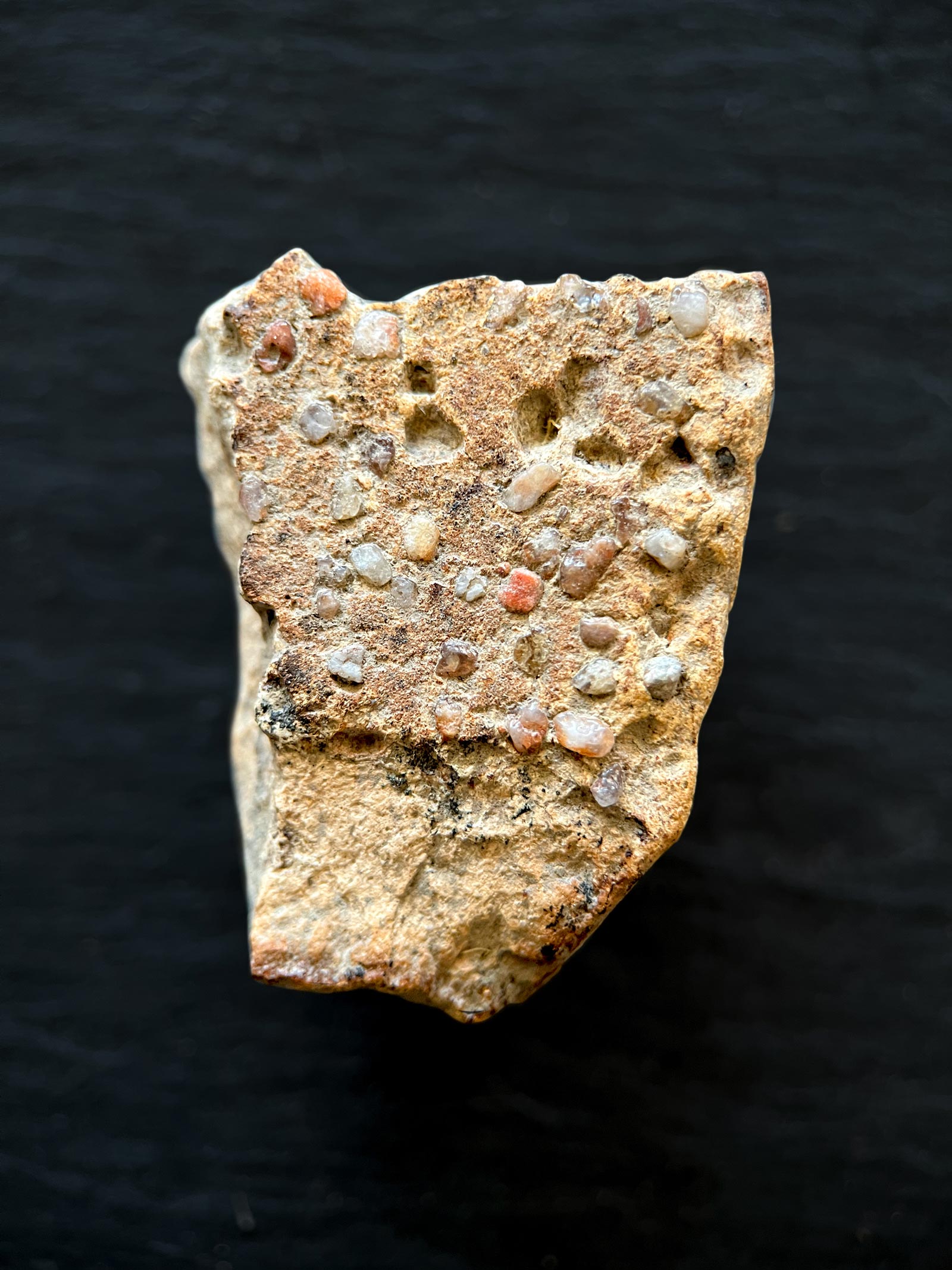
It’s interesting to note that one of the pottery sherds that I picked up was part of a roman mortarium bowl (Fig.8). This is great evidence that people were actually living here, because mortariums were a staple part of Roman meal preparation. The interior walls and base of the mortarium were embedded with coarse stone or quartz grit to help grind and blend things like herbs and spices, and to make condiments such as garum. This sherd is lined with quartz grit which would likely place it in the earlier period of the Roman occupation of Britain.
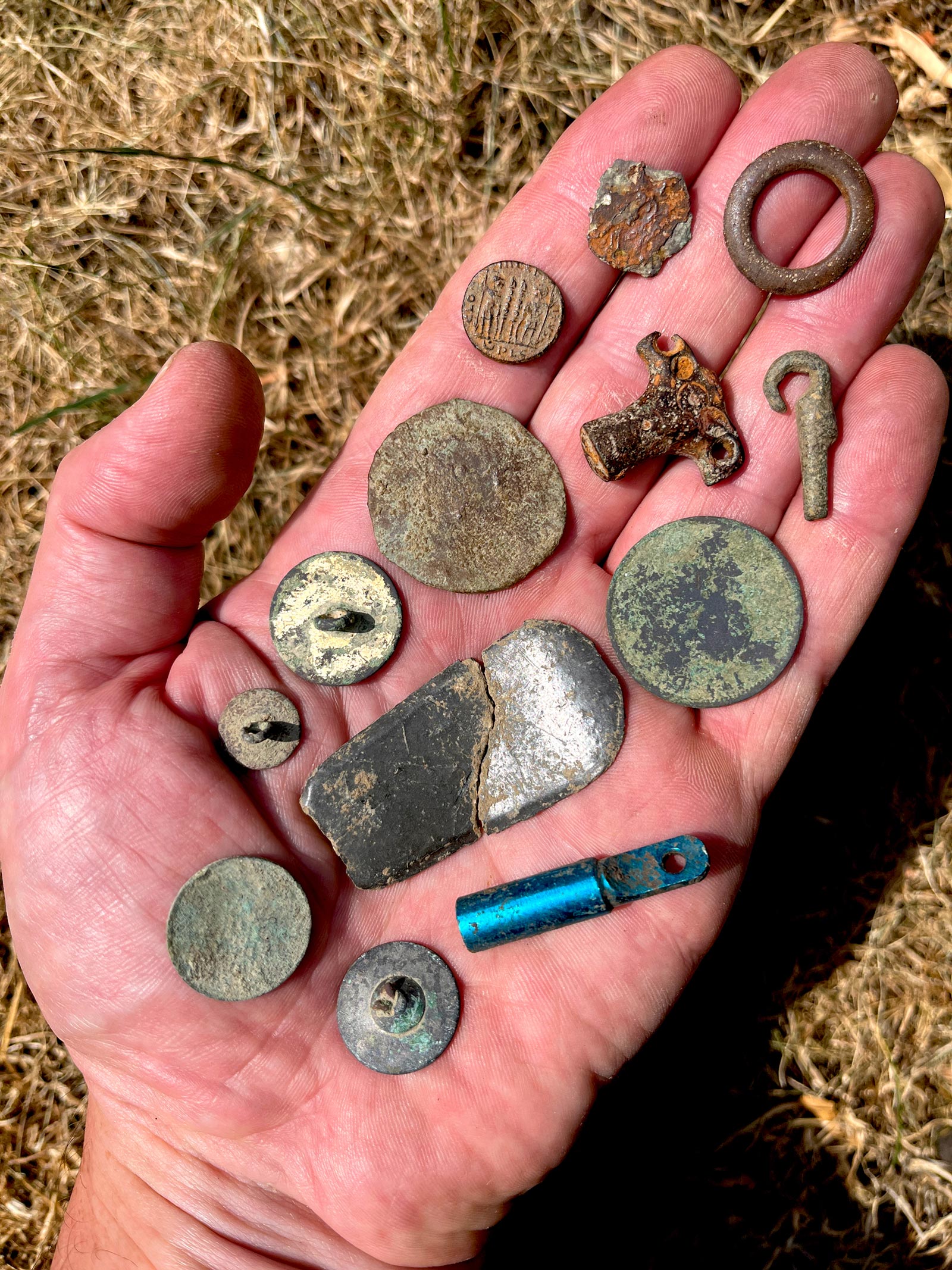
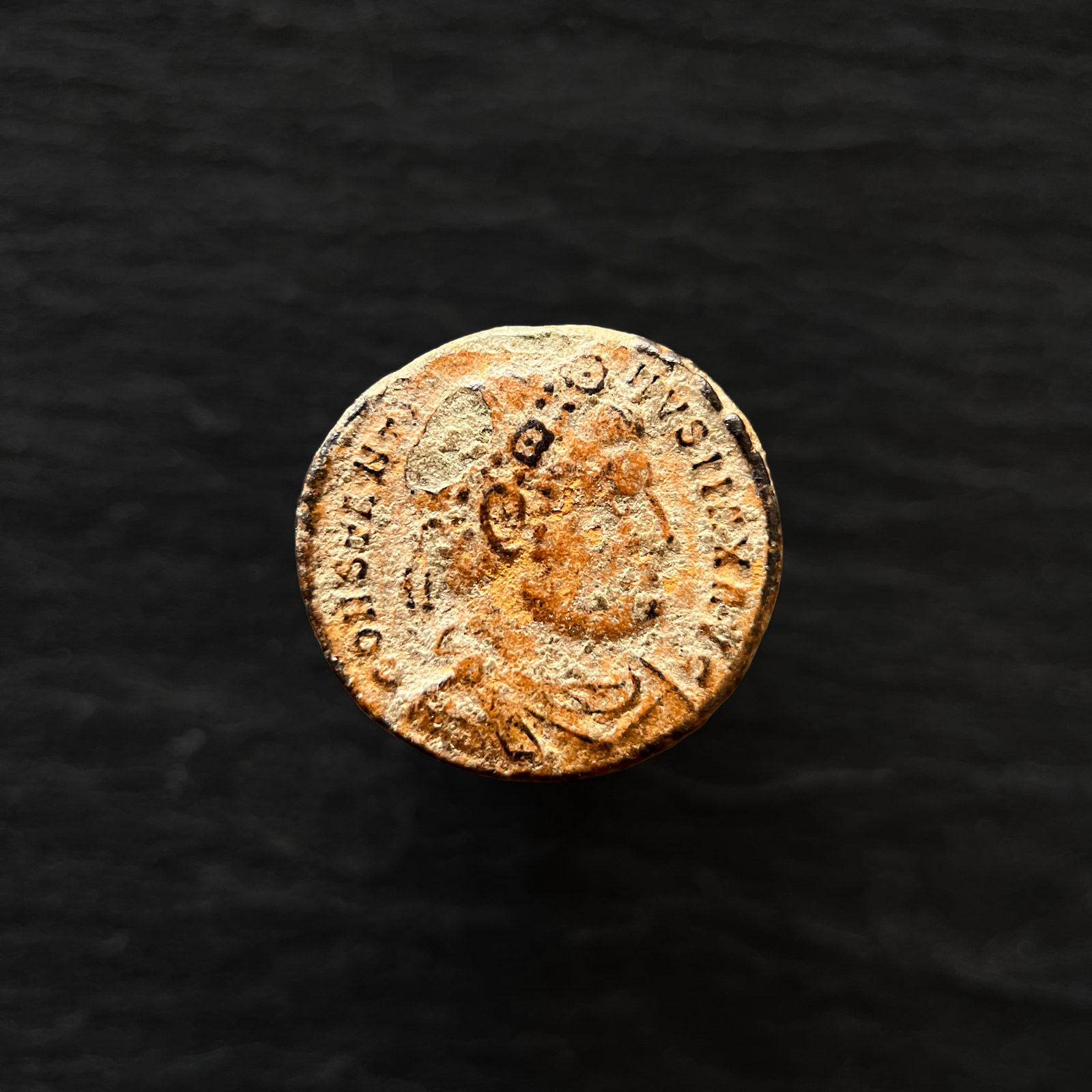
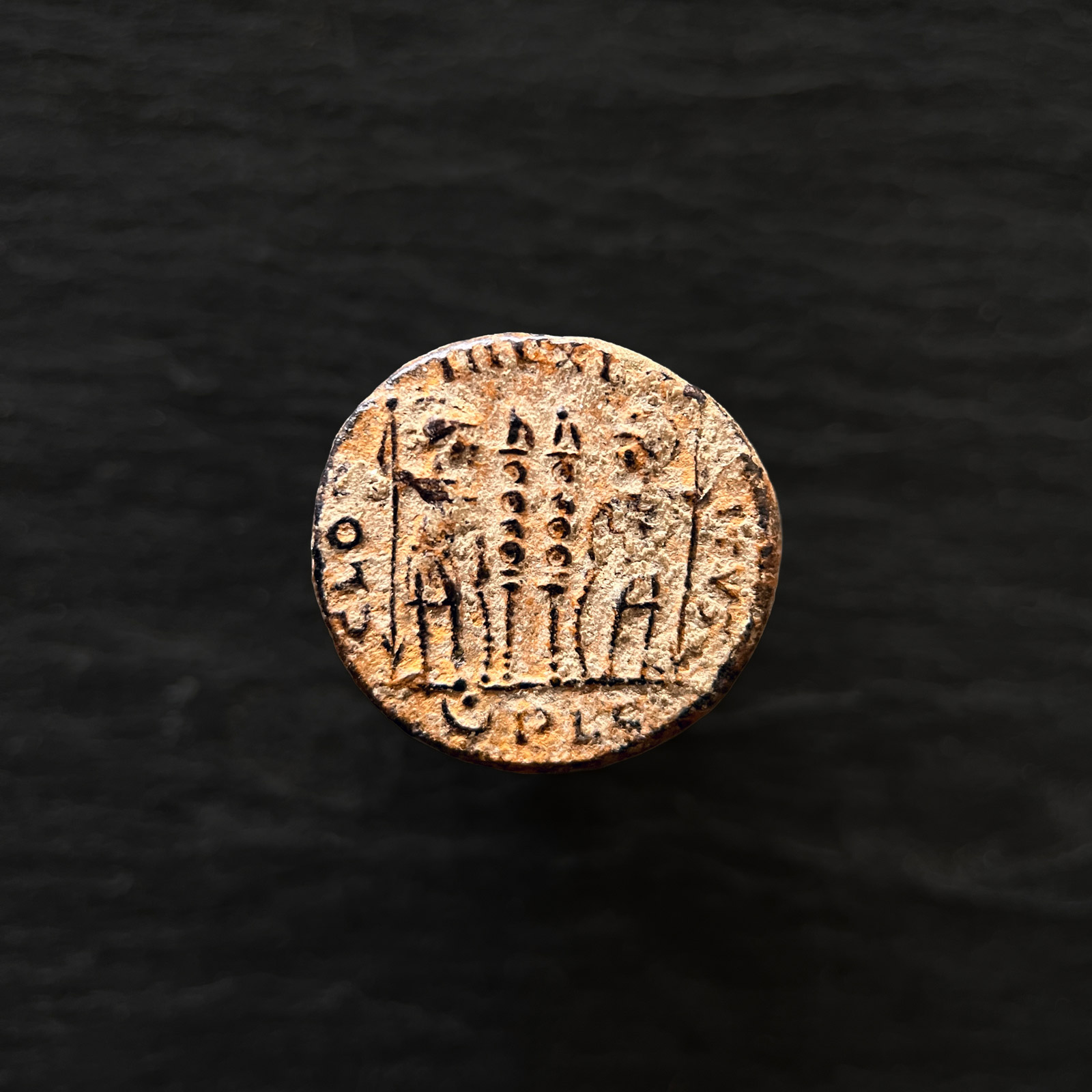
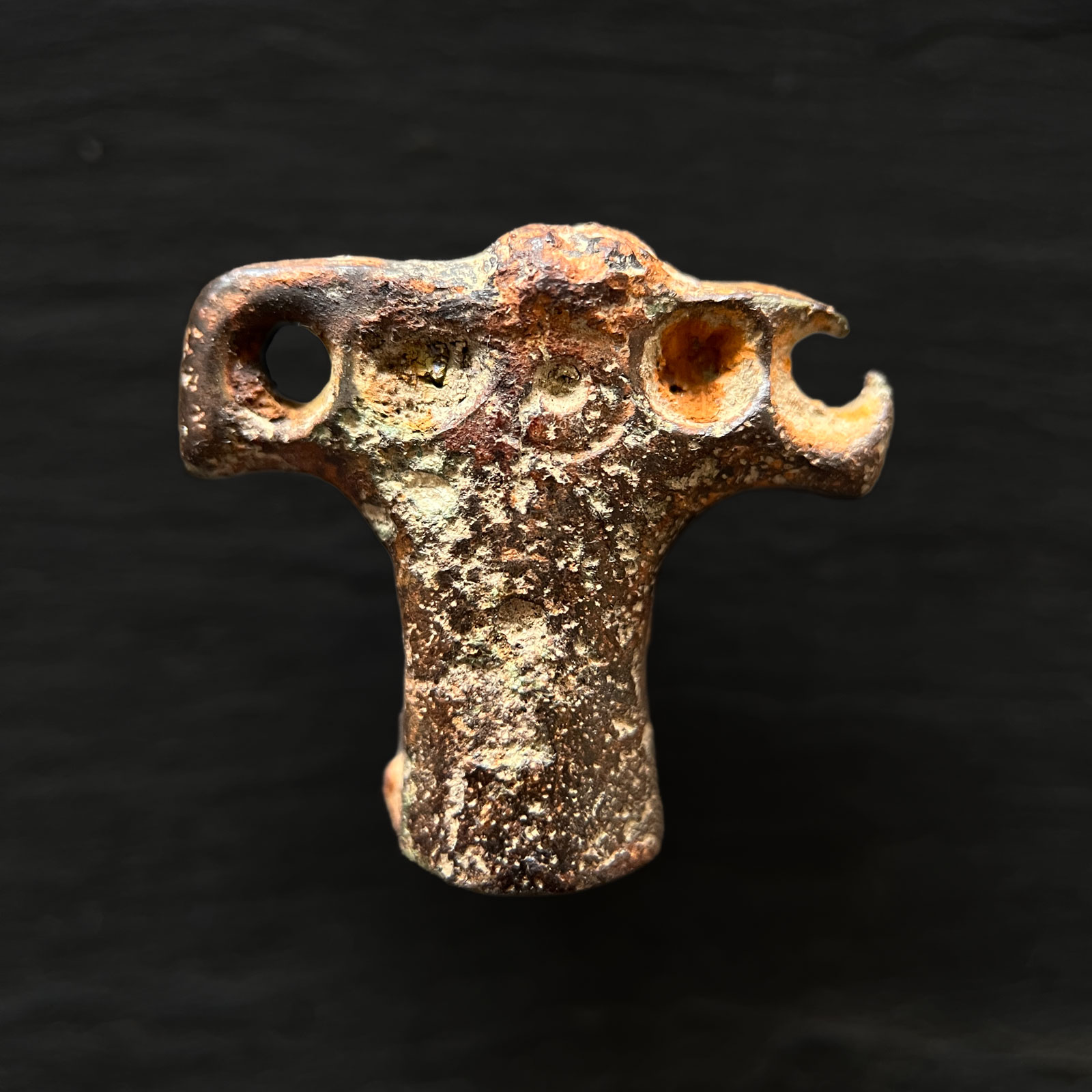
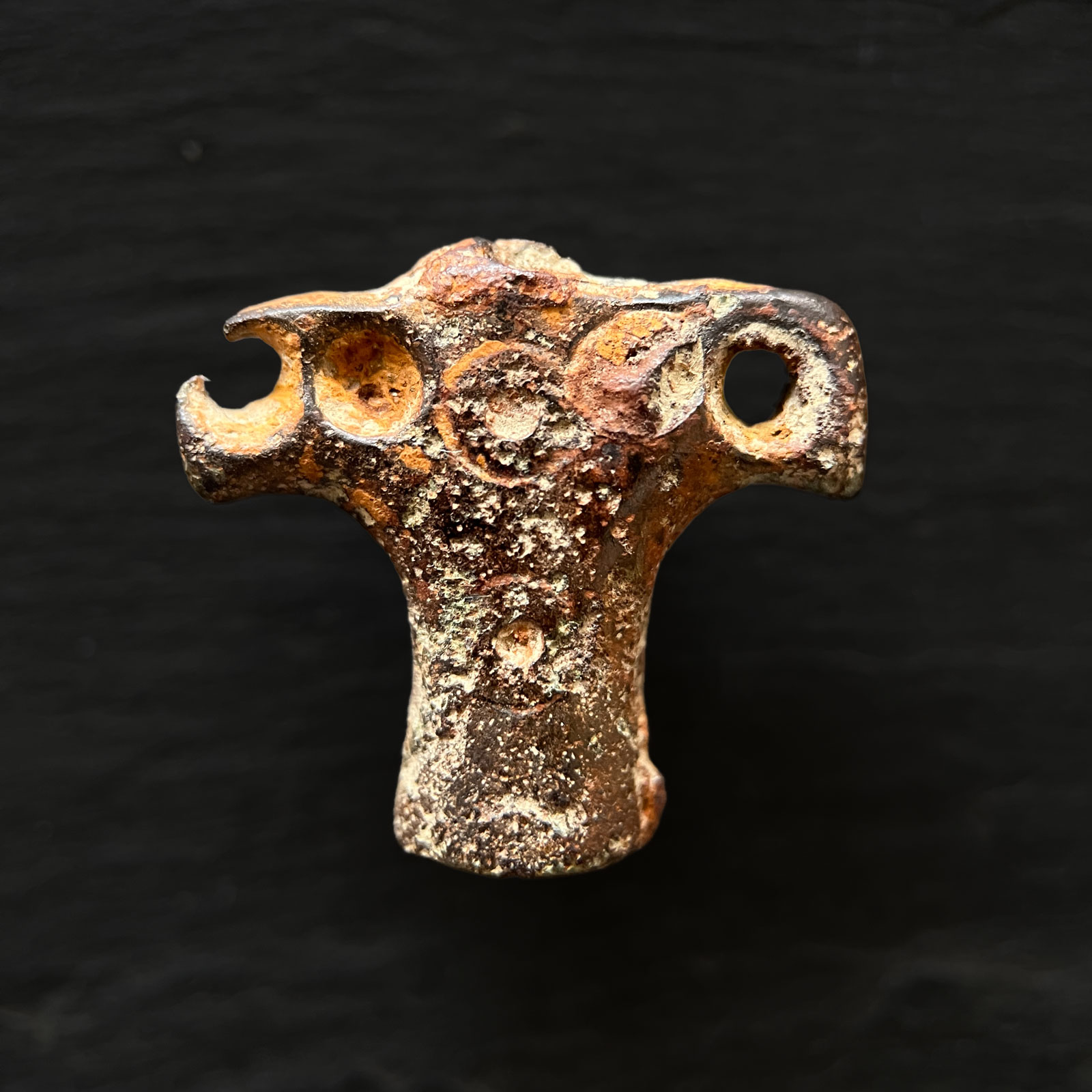
The next outing on the site produced a few more Roman coins to add to the collection (Fig.9). One of these coins would turn out to be the highlight of my survey, which was a Nummus of Constantine (Figs.10a & 10b) and dates to around 330AD. Another interesting find from this bunch can be seen in closer detail in Figs.11a & 11b. The closest reference that I could find on the Portable Antiquities Scheme is that it maybe part of a handle from a Roman knife, razor or spatula. Gil wondered if it may have been part of a key handle, in any case, another good find from the Roman period. It would now be a while before I got out on to site again, but the next outing was going to be good for spotting pottery sherds again, due to a little bit of rain.
It soon became clear towards the end of the allotted time on this permission, that the field walking exercises weren’t going to take place. This was due to various reasons, but it ultimately meant that for this survey it would only be my time in the field that would be contributing to our understanding of what was going on here. This meant that on the next couple of outings I needed to pick up some more pottery sherds for dating purposes.
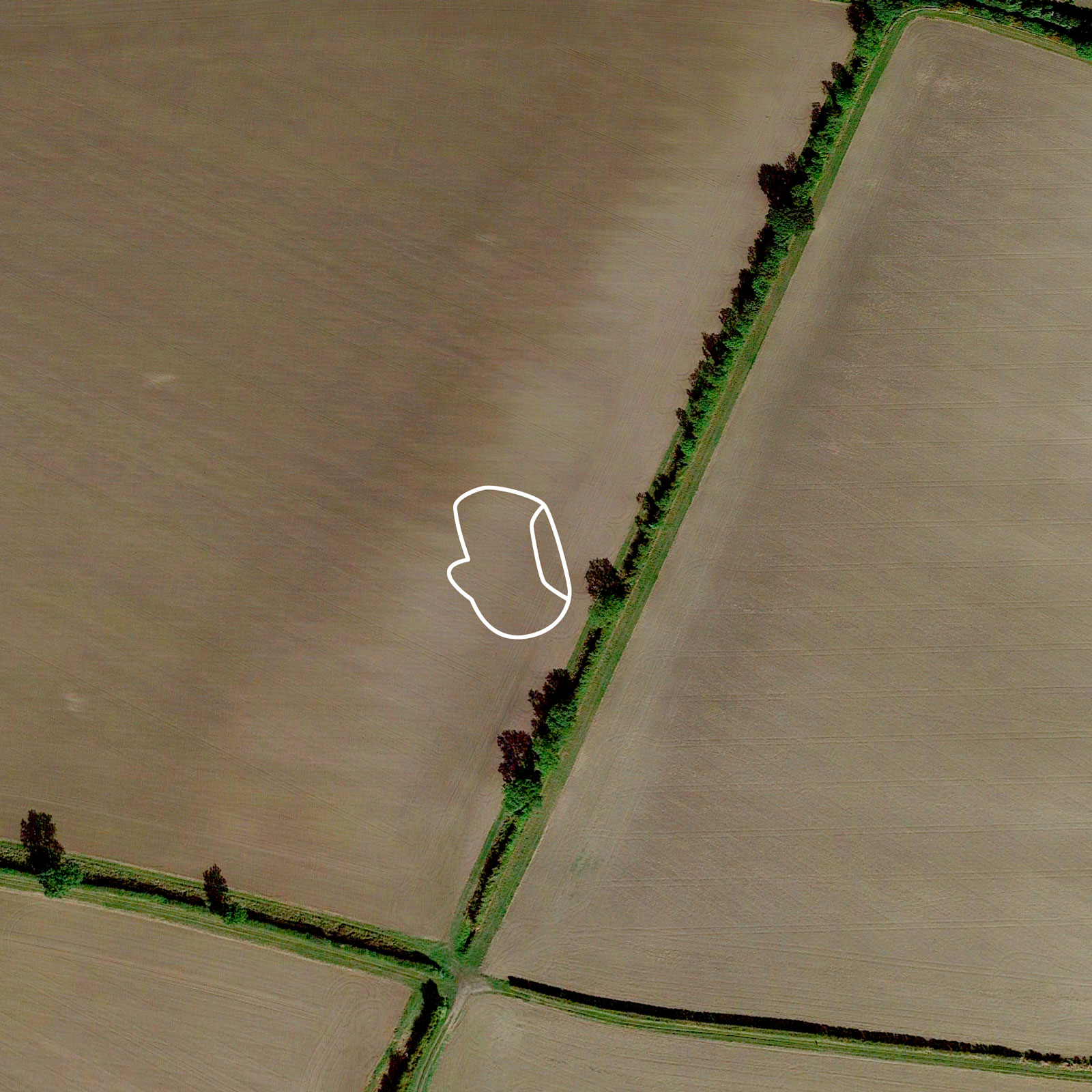
The archaeological feature that I was investigating was fairly close to a ditch which can be seen in Fig.12. So on the next session I decided to see if the finds extended in to the field on the other side. I had to ask for permission to do this, which was duly granted, and it brought up some interesting results. I had some more Roman coins come up, as you can see in Fig.13, and they were a lot bigger than any of the coins found so far. These coins are known as Sestertii, we know this due to their size and weight regardless of the terrible condition they are in. The Sestertius was the biggest coin used in Roman currency, and it was produced until the late 3rd century so it’s another good source for dating this site.
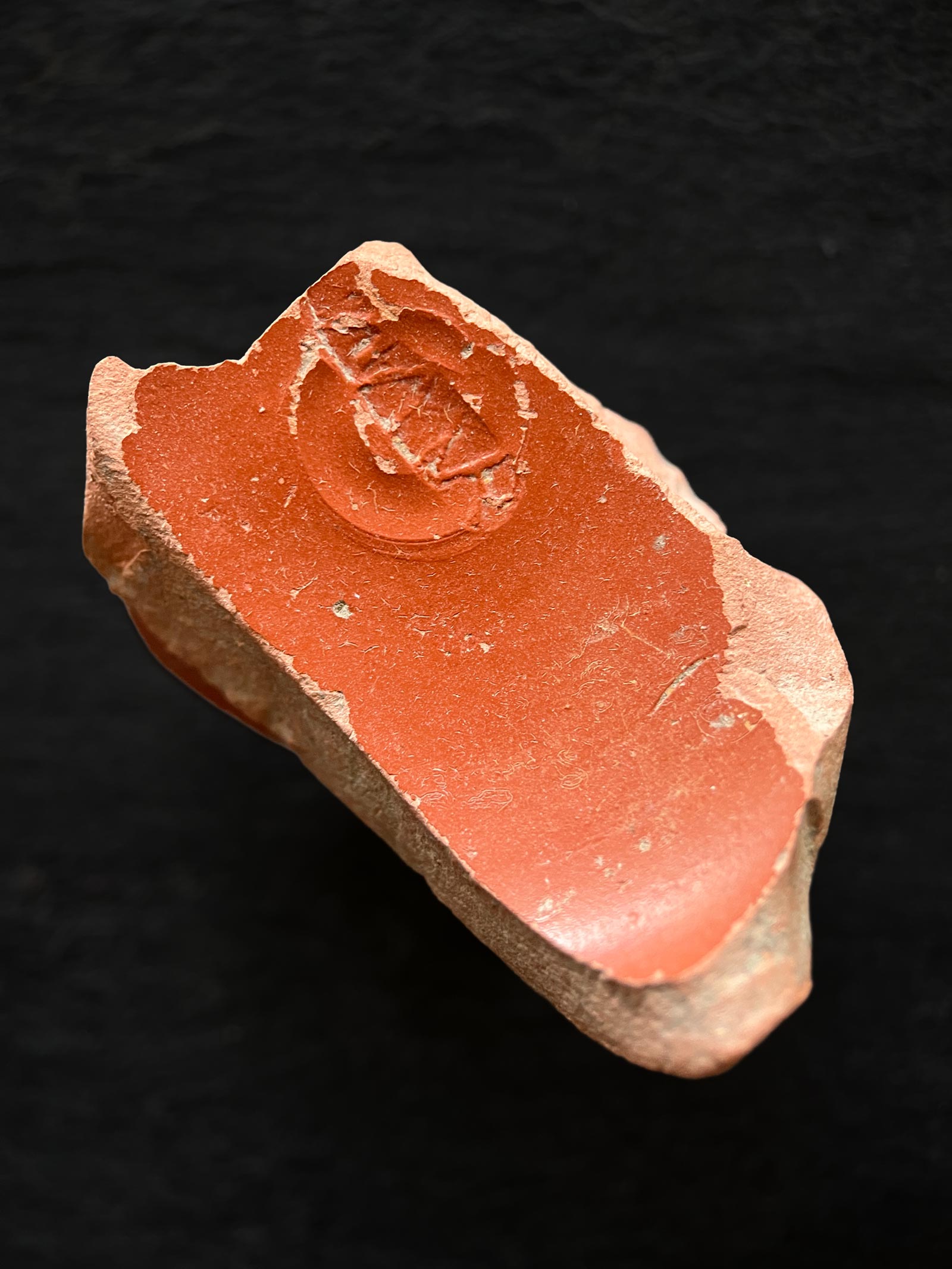
But the best finds in my hand are the sherds of Roman samian ware pottery. This was the upper market pottery of Roman society, which is also another good reference to give us information about the status of the people who were living here. Even better is the fact that the sherd I found had the makers stamp on it (Fig.14), although I have yet to identify who the maker was. Weirdly I only found the samain pottery sherds on this side of the ditch and I have no idea why. After showing the images to Keith, he revealed “It’s stamped samian ware, made in Gaul during the first and second centuries”. He went on to add “It looks like a form Dr 27, a bi-lobed cup. Interestingly, the upper half has precisely twice the volume of the lower, and it’s been suggested that they may have been used for making and serving an oil and garum based dressing like a French dressing’.
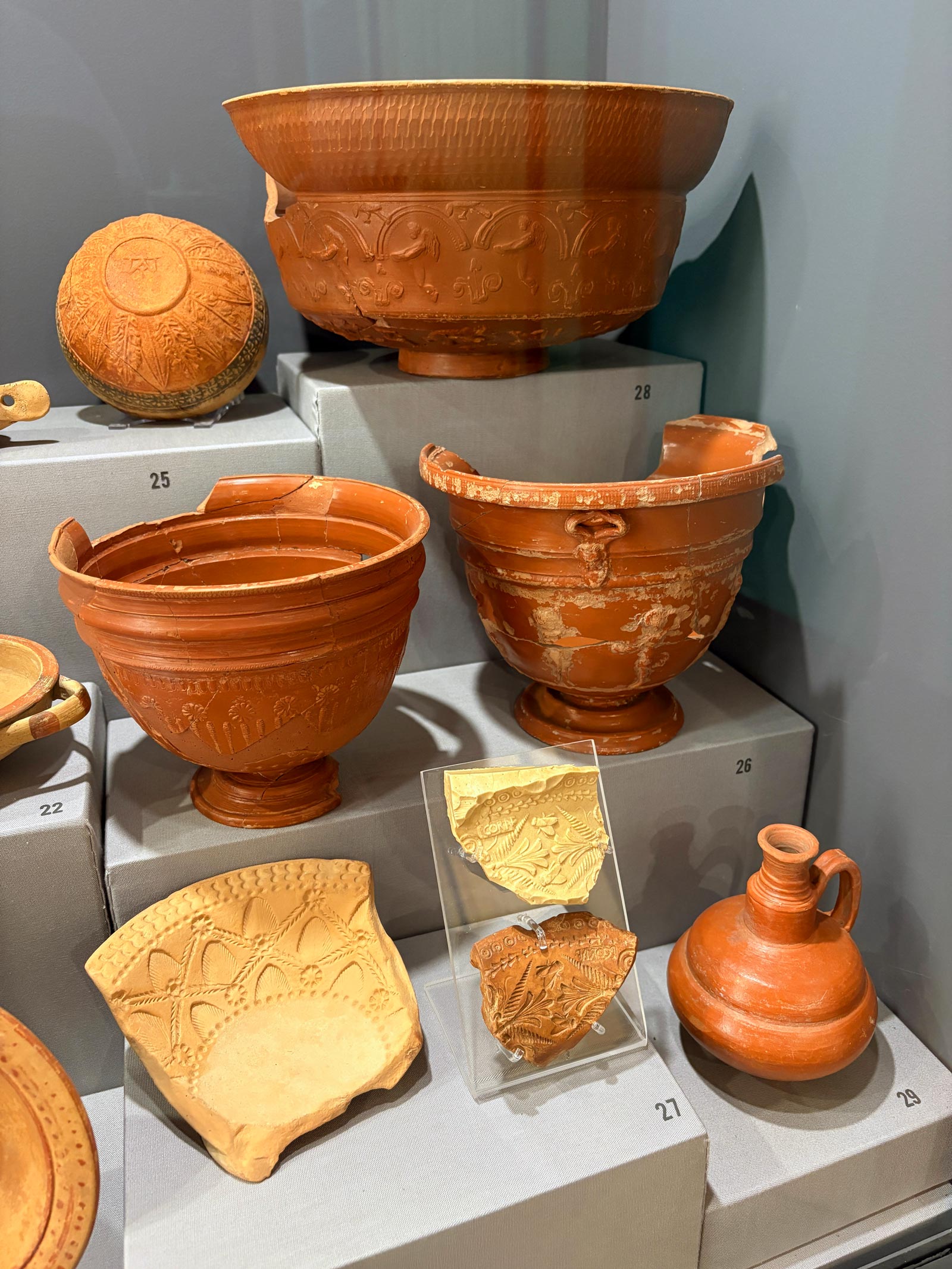
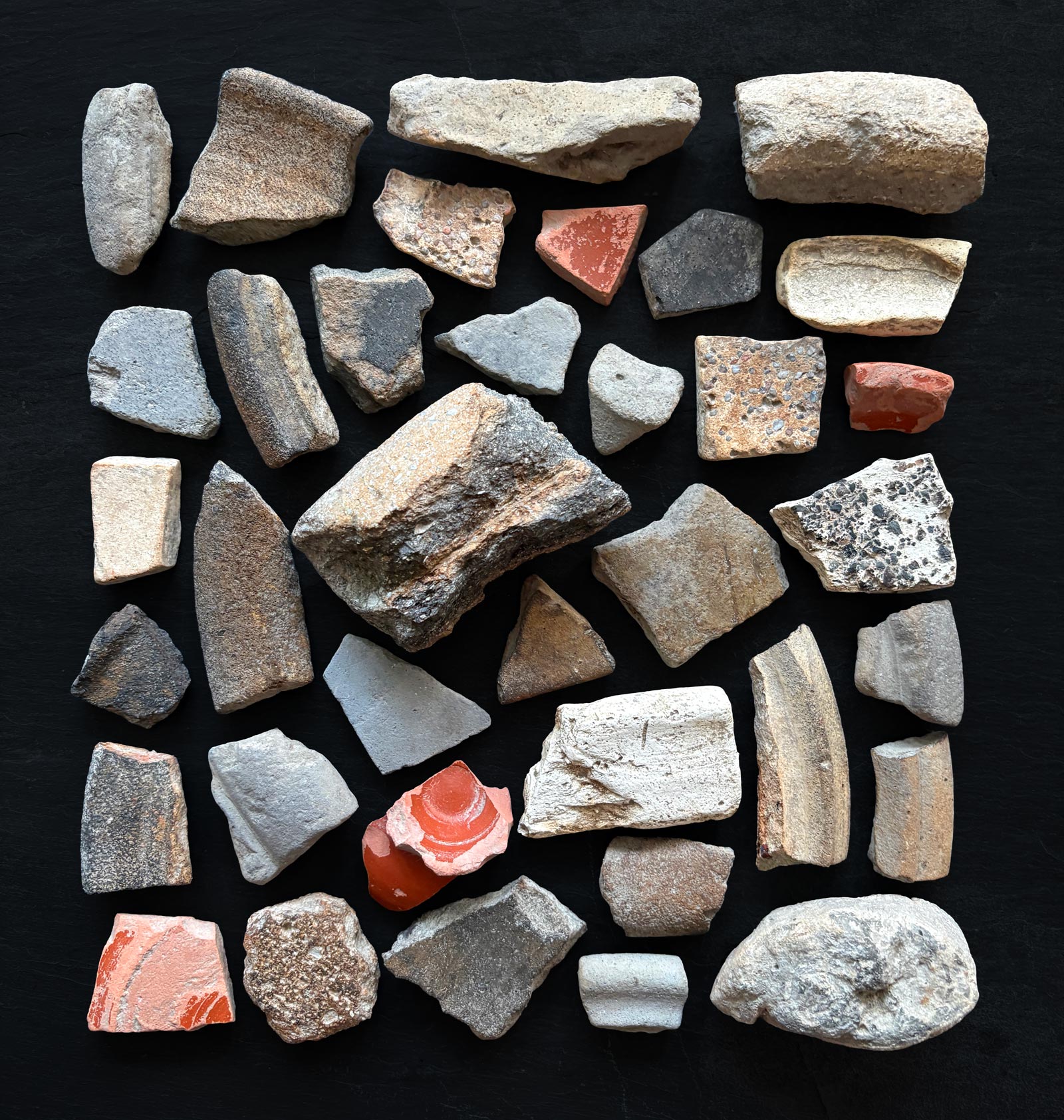
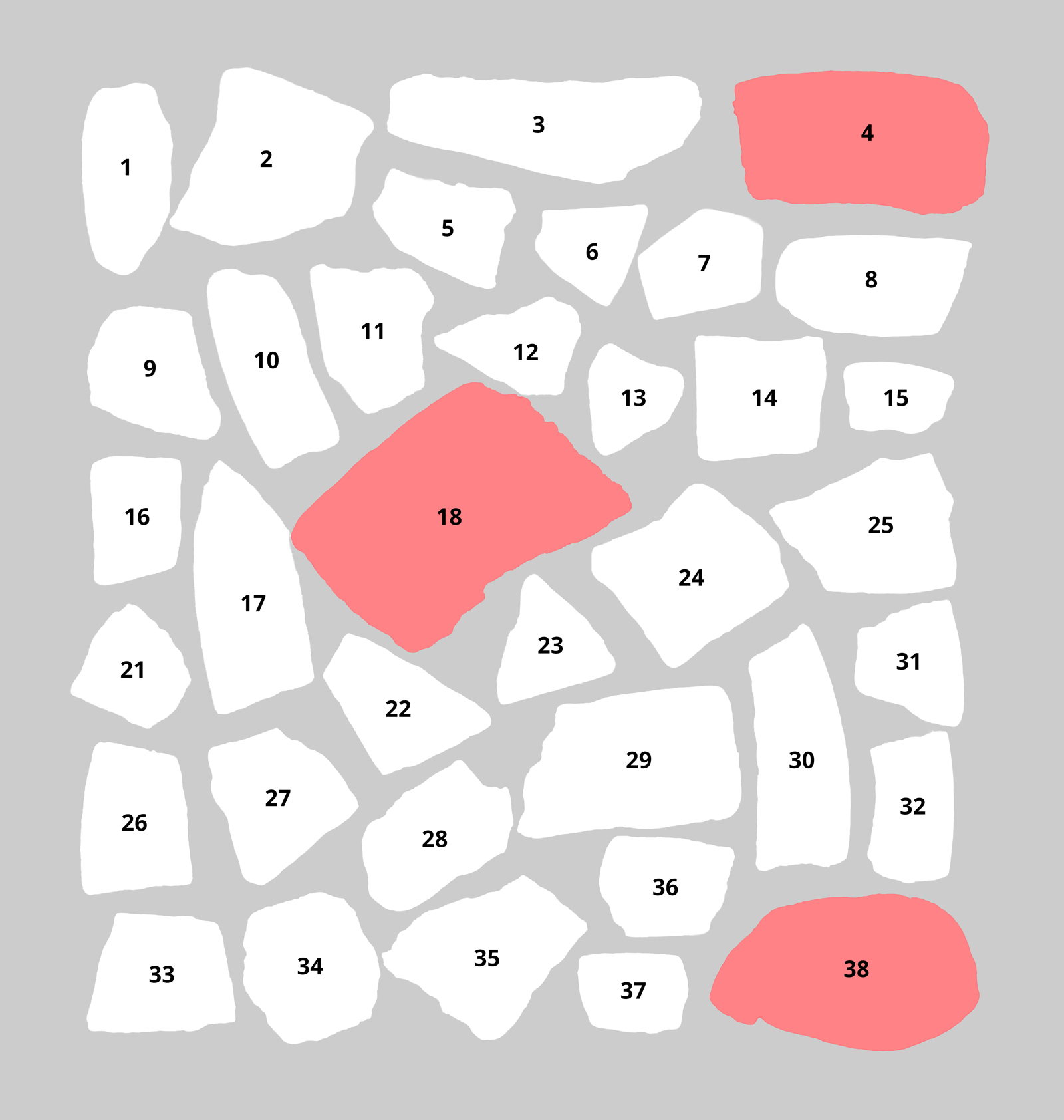
This ties in nicely with the mortarium sherd which I found (Fig.8), as mortariums are known to have been used to make and prepare garum. A few weeks after this I had my first trip to Rome, where in one of the museums I happen to see some samian ware which I took photos of to add to this article for context (Fig.15). I continued to pick up pottery sherds from both sides of the ditch which you can see in Fig.16. I took the sherds to North Herts Museum to see Keith in person, and he was able to date most of them to various parts of the Roman period. But three sherds in particular he was able to date to the late Iron Age, as marked in red in Fig.17. It’s great evidence that this site may have been active before the Roman occupation of Britain, it’s just a shame I found no metal artefacts to back this up… yet.
So with my time on this site at an end, I think overall it’s been quite successful. But if I’m honest, with the amount of pottery sherds I was seeing, I would have expected to find a lot more on the metallic finds front than I did. It makes me wonder if other detectorists have been here in the years since the early 1990’s? If they have, and they found things after 1997, then none of it has been recorded on the Portable Antiquities Scheme, which is frustrating. But then it’s also possible that there isn’t much to find here metal wise, but then all those pottery sherds…
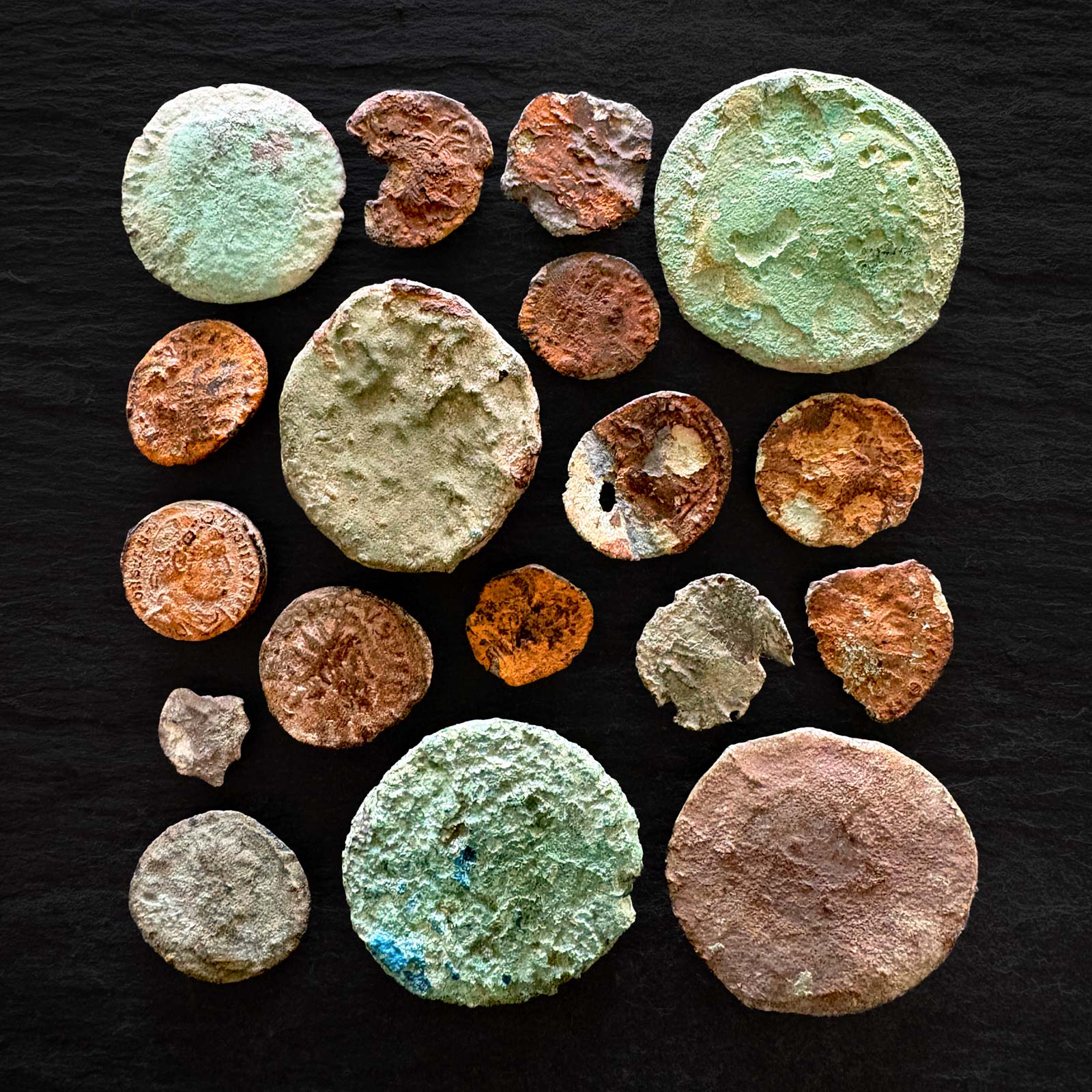
Still, I think my metal detecting survey has been a good start to get our understanding of what was happening here underway. There were 18 Roman coins in total (Fig.18), as well as other artefacts and a good scatter of pottery sherds, so what does this tell us? Well, I’m not an archaeologist so I couldn’t begin to tell you, other than the broader period is definitely Roman. So I leave the question of what was going on here to Gil and Keith, who, with there expertise, will hopefully have an opinion which I can add to this article in due course.